Okay, okay, what is actually SUCCEEDING in our summer garden? Other than our hugely successful pea harvest and respectable carrot, onion, and potato harvests, our attention is now focused mostly on the contents of Quads 3 & 4.
In between weeds, we have lots of winter squash and beans coming up. Beyond that towards the upper right corner we have tomatoes, garlic, summer squash, okra, and peppers.
I can't wait for these little peps to get big!
That said, there are plenty of surprises going on. Back up in Quad 1, where just about everything is kaput, I am surprised at the red malabar "spinach."
It's not a true spinach, but it is very similar in taste and nutrition. It took FOREVER to germinate, which makes sense because this is definitely a hot weather plant. Yum!
Bill apparently looked up the seed pods coming out all over our neglected radishes, and apparently they are edible, like beans:
I've mentioned the onions flowering, which is a shame because they can't be stored as long. However, they are pretty:
The biggest surprise has been in the strawberry patch. We left for my sister's wedding and it looked like a normal patch of strawberry plants, but when we came up, we found this:
An entire corner completely taken over by cantaloupe! Now, it's not a mystery how these plants located themselves here, as this is where they were planted last year. It's just crazy how well the plants reseeded and stuck around through the winter. I debated moving them over to where I've planted more cantaloupe, but decided against it because they are so mature and thriving. I'm just directing them away from the strawberry plants.
Showing posts with label garden 2010. Show all posts
Thursday, June 10, 2010
Wednesday, June 9, 2010
Bring It On Summer, Part 2
Summer brings not only harvest, but also death.
This is what just a few days of not watering will do to my lovely flowers. They all look like this. I'm glad I got pictures while they were pretty.
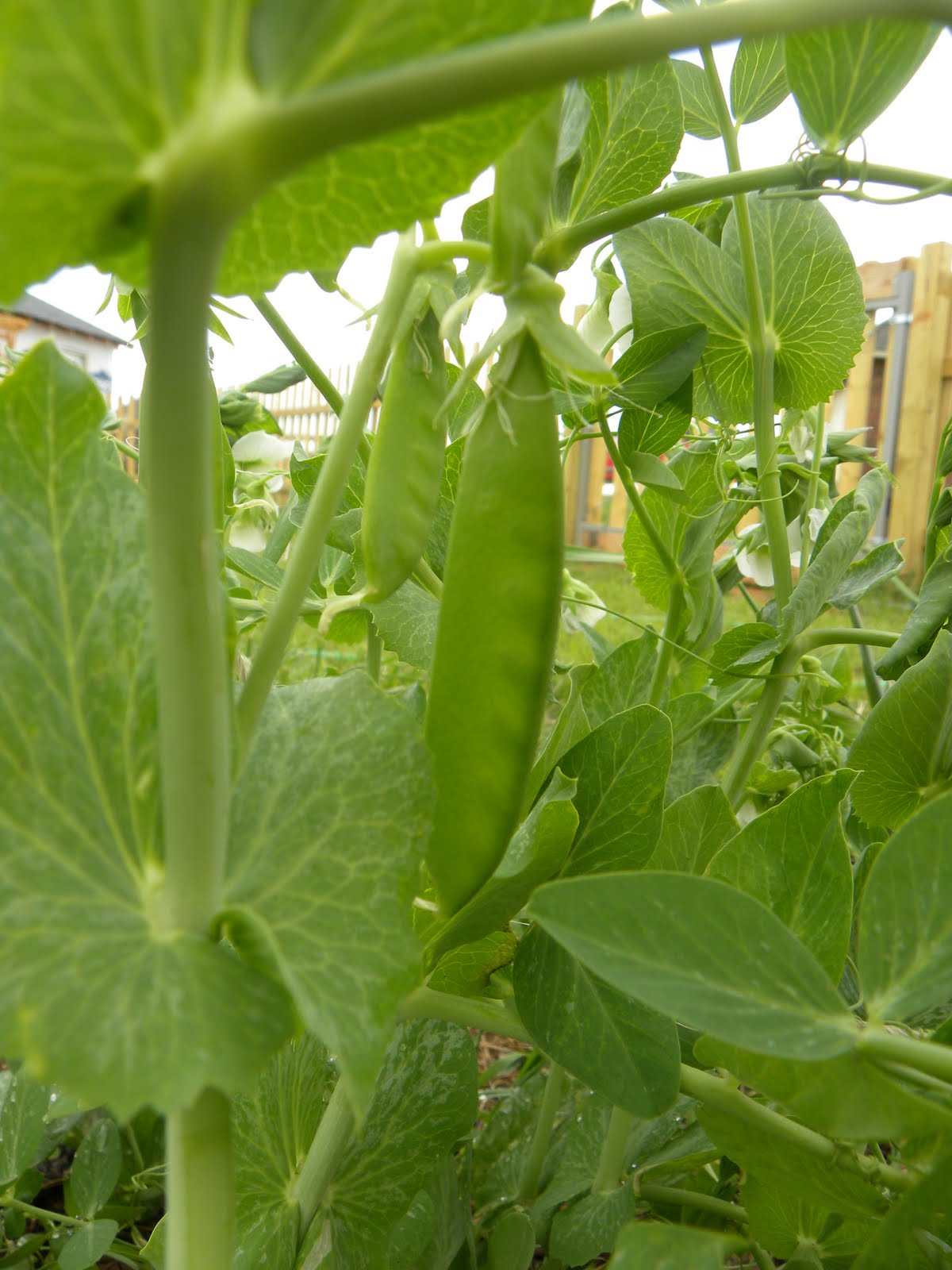
Also, the peas are pooped.
I'm not sad to see them die, though, because we got a great harvest from them and I'm a little sick of spending every single evening shelling peas. When we're back from our next vacation jaunt, we'll mow these down and turn the roots under. They are busy fixing nitrogen in the soil right now, so this area will be prime for replanting other foods for the fall. I'm envisioning an entire quad of cauliflower.
Another casualty, so-to-speak, of the heat is the lettuces:
They have officially gone to seed, though they look rather pretty like this. I have to admit that while the romaine was the first to bolt, the red flame lettuce took it's time. I will definitely plant more of that.
What IS still thriving, you ask? Um, can you say WEEDS?
Yeah. See any actual vegetables in that thicket? I almost wish I could turn the bunnies loose in here and let them eat everything down, but I know they'd either go straight for the carrots or the hole in the fence.
I know this was a pretty bleak post, but there are lots of successes still to be had. Yeah...I decided to make this more than 2 parts, so stay tuned.
This is what just a few days of not watering will do to my lovely flowers. They all look like this. I'm glad I got pictures while they were pretty.
Also, the peas are pooped.
I'm not sad to see them die, though, because we got a great harvest from them and I'm a little sick of spending every single evening shelling peas. When we're back from our next vacation jaunt, we'll mow these down and turn the roots under. They are busy fixing nitrogen in the soil right now, so this area will be prime for replanting other foods for the fall. I'm envisioning an entire quad of cauliflower.
Another casualty, so-to-speak, of the heat is the lettuces:
They have officially gone to seed, though they look rather pretty like this. I have to admit that while the romaine was the first to bolt, the red flame lettuce took it's time. I will definitely plant more of that.
What IS still thriving, you ask? Um, can you say WEEDS?
Yeah. See any actual vegetables in that thicket? I almost wish I could turn the bunnies loose in here and let them eat everything down, but I know they'd either go straight for the carrots or the hole in the fence.
I know this was a pretty bleak post, but there are lots of successes still to be had. Yeah...I decided to make this more than 2 parts, so stay tuned.
Friday, June 4, 2010
Bring It On Summer (Part 1)
In order to make up for my lack of blogging, I've come up with a 2-part post (maybe more) to catch you up on the garden activities of late.
Part 1 is about our recent harvests. We've steadily been picking snow peas and shelling peas for just about a month. Snow peas have petered out and shelling peas probably only have 1 more small picking session left. Want to see how we've done this year?
We started picking peas every night before dinner (recall this post) and Bill and I would shell or destring as necessary, blanch, and tray freeze batches of them after Joe went to bed.
Now to compare, last year we harvested exactly these many shelling peas from the garden:
That is approximately HALF of 1/2 cup of peas. Yes, 1/4 cup of peas. Barely a Joe-sized fistful.
We did a little better this year:
Two full gallons, and we're not quite finished yet, though the 100+ temps have mostly halted pea production for good. Now, considering how fast we go through peas--the one vegetable Joe will ALWAYS eat--this will probably last us maybe a month, if I'm lucky. But it still feels nice to have homegrown veggies in the freezer. And speaking of freezer...
This, my friends, is an entire freezer shelf full of snow peas, packaged by the pound and quarter-pound. We hauled in a grand total of 9lbs of snow peas from ONE 25-foot row. This doesn't include what we ate fresh from the garden, either. I think if we had done another row and hadn't gone on vacation in the middle of the harvest, we might have been able to freeze enough to last until winter. Crazy.
While we're in the freezer, might as well show you the first of the carrot harvest:
Just a pint-sized bag of carrot coins, but more than we got last year by a long shot. There are still tons of carrots out in the garden waiting to be picked, but this is what we got while thinning them out.
Next up are taters & onions:
Not a lot of potatoes, considering I dug up 6 plants to get these. The plants were nowhere near mature, but we're in the midst of a full-on war with the potato beetles, and it was either dig or nothing. These I'll mash up and throw on top of a shepherd's pie this weekend.
The onions above are much more exciting. These represent a tiny fraction of what is still waiting out in the garden, and they are nice, large bulbs. Some I will cure and store in the root cellar/storm shelter and some I will chop up and freeze.
All of this is a fairly upbeat and optimistic view of what's going on out there, but trust me, the whole picture ain't pretty. I've mentioned the extreme heat and vacation; both of these resulted in almost all of my flowers dying, hot-weather weeds dominating the garden, and no more lettuce. Those pics are to come in the next part.
Part 1 is about our recent harvests. We've steadily been picking snow peas and shelling peas for just about a month. Snow peas have petered out and shelling peas probably only have 1 more small picking session left. Want to see how we've done this year?
We started picking peas every night before dinner (recall this post) and Bill and I would shell or destring as necessary, blanch, and tray freeze batches of them after Joe went to bed.
Now to compare, last year we harvested exactly these many shelling peas from the garden:
That is approximately HALF of 1/2 cup of peas. Yes, 1/4 cup of peas. Barely a Joe-sized fistful.
We did a little better this year:
Two full gallons, and we're not quite finished yet, though the 100+ temps have mostly halted pea production for good. Now, considering how fast we go through peas--the one vegetable Joe will ALWAYS eat--this will probably last us maybe a month, if I'm lucky. But it still feels nice to have homegrown veggies in the freezer. And speaking of freezer...
This, my friends, is an entire freezer shelf full of snow peas, packaged by the pound and quarter-pound. We hauled in a grand total of 9lbs of snow peas from ONE 25-foot row. This doesn't include what we ate fresh from the garden, either. I think if we had done another row and hadn't gone on vacation in the middle of the harvest, we might have been able to freeze enough to last until winter. Crazy.
While we're in the freezer, might as well show you the first of the carrot harvest:
Just a pint-sized bag of carrot coins, but more than we got last year by a long shot. There are still tons of carrots out in the garden waiting to be picked, but this is what we got while thinning them out.
Next up are taters & onions:
Not a lot of potatoes, considering I dug up 6 plants to get these. The plants were nowhere near mature, but we're in the midst of a full-on war with the potato beetles, and it was either dig or nothing. These I'll mash up and throw on top of a shepherd's pie this weekend.
The onions above are much more exciting. These represent a tiny fraction of what is still waiting out in the garden, and they are nice, large bulbs. Some I will cure and store in the root cellar/storm shelter and some I will chop up and freeze.
All of this is a fairly upbeat and optimistic view of what's going on out there, but trust me, the whole picture ain't pretty. I've mentioned the extreme heat and vacation; both of these resulted in almost all of my flowers dying, hot-weather weeds dominating the garden, and no more lettuce. Those pics are to come in the next part.
Friday, May 21, 2010
How Our Garden Grows
Lettuce rainforest
Radish flowers--this is what happens when you don't harvest radishes.
One of the green bean rows--this one is between potatoes.
The corn is coming up.
Winter squashes--I think this one is butternut.
Shallots in the strawberry bed.
Random indeterminite squash growing out of the compost bin. We're waiting to see what it is, so we haven't turned the compost in a while.
Ravenous, massive rabbits. Knock on wood, we haven't seen any signs of baby bunnies on the way yet. Maybe we lucked out with these two. We definitely have them to thank for our fertilized garden, as they have proven to be pro poopers.
Radish flowers--this is what happens when you don't harvest radishes.
One of the green bean rows--this one is between potatoes.
The corn is coming up.
Winter squashes--I think this one is butternut.
Shallots in the strawberry bed.
Random indeterminite squash growing out of the compost bin. We're waiting to see what it is, so we haven't turned the compost in a while.
Ravenous, massive rabbits. Knock on wood, we haven't seen any signs of baby bunnies on the way yet. Maybe we lucked out with these two. We definitely have them to thank for our fertilized garden, as they have proven to be pro poopers.
Thursday, May 20, 2010
Tuesday, May 4, 2010
My Quads are Burning
Yes, that is a play on words which include both my aching legs and the re-energized garden quads. So, it should be no big surprise that I didn't accomplish everything on my list from last week, though I did get some of it done. It turns out that last week was even busier than I thought it would be, because of extra work and no babysitter.
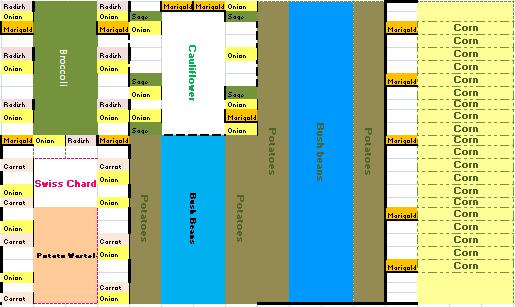
However, we did make progress. First of all, Quad 2 is finally planted out. This what it looks like on paper:
I updated the spreadsheet with the fact that there is a potato wasteland at the end of one of the rows because the trench got flooded out and the taters died. We have since filled it in and I'm debating what will fill the space. This is what the quad actually looks like now:
Right to Left: Row 1: Broccoli/Onions/Radish/Swiss Chard. Row 2: Cauliflower/Radish/Potatoes/Beans. Row 3: Potatoes/Beans. Row 4: Corn.
I'll have to replant cauliflower in the fall because several of my seedlings have been eaten. We planted corn this weekend, and I'm not getting my hopes up because Oklahoma is tough on corn. If we harvest enough for 1 late summer meal, I'll be happy, even though I planted 16 rows of 5-6 seeds each.
Bill did the hard work of filling dirt in the potato trenches, and I planted green beans in a single row down the middle:
I actually found one sprouting just 24 hours after planting. I take that as a positive omen. I'm also please that some of the taters are blooming, which means we're getting ever closer to eating potatoes:
We're already enjoying the Swiss Chard, which was an experiment this year as I'd never cooked with it before. So far we've eaten it in salads, roasted with pork chops, and sauteed with spinach and garlic.
Quad 3 is a little over halfway planted, but it needs some work.
As you can see, there are a few rows in the middle that need to be planted. From left to right are 2 rows of peppers, nothing, a row of garlic, and 2 rows of tomatoes. There are herbs growing throughout and 4 eggplants in with the peppers.
The peppers seem to be doing well, but I can't say the same for the tomatoes. I did a poor job of hardening off the seedlings, and some of them succumbed to weather/pests. I'm going to pick up some replacement plants this week to fill empty spots. In the middle of Quad 3 will go okra, zucchini, yellow squash, and if there is room, purple hull peas. All of these things are normally planted later, which is why I've been lazy about getting them in.
Quad 4 presented a design challenge that I have finally worked out. This is where my winter squashes and remaining legumes are supposed to go, but I wasn't sure how I could lay out the space with enough room for the vining squashes to spread out while keeping them somewhat separated from each other in case we have another squash bug attack this year. What I came up with was alternating squash hills with bean sections.
It's kind of hard to see the mounds in this picture, but the beans are in the darker blocks and the squash mounds are in between. Each row will alternate so that the mounds will be little islands in the beans, and hopefully the beans will act as a barrier for squashbugs. Time will tell. I haven't finished prepping this quad because I ran out of bagged compost, but the blocks above are planted with beans.
Quad 1 is doing really well, and its success is keeping me sustained as I work through the other quads. Look how lush:
Okay, admittedly this picture is a little misleading because a lot of the green is weeds and grass. But the lettuces and spinach are doing very well, and I may be able to start freezing some spinach for later in the summer soon.
Carrots are coming up all over the place, and we probably could start digging up some to see if they are ready. The peas and snow peas blossomed late last week, so there are pods shooting out here and there. Tomorrow we will eat our first harvest of snow peas for dinner.
So there you have it. There is still a lot of work and planting left to be done, and I hope that I'm not too late.
However, we did make progress. First of all, Quad 2 is finally planted out. This what it looks like on paper:
I updated the spreadsheet with the fact that there is a potato wasteland at the end of one of the rows because the trench got flooded out and the taters died. We have since filled it in and I'm debating what will fill the space. This is what the quad actually looks like now:
Right to Left: Row 1: Broccoli/Onions/Radish/Swiss Chard. Row 2: Cauliflower/Radish/Potatoes/Beans. Row 3: Potatoes/Beans. Row 4: Corn.
I'll have to replant cauliflower in the fall because several of my seedlings have been eaten. We planted corn this weekend, and I'm not getting my hopes up because Oklahoma is tough on corn. If we harvest enough for 1 late summer meal, I'll be happy, even though I planted 16 rows of 5-6 seeds each.
Bill did the hard work of filling dirt in the potato trenches, and I planted green beans in a single row down the middle:
I actually found one sprouting just 24 hours after planting. I take that as a positive omen. I'm also please that some of the taters are blooming, which means we're getting ever closer to eating potatoes:
We're already enjoying the Swiss Chard, which was an experiment this year as I'd never cooked with it before. So far we've eaten it in salads, roasted with pork chops, and sauteed with spinach and garlic.
Quad 3 is a little over halfway planted, but it needs some work.
As you can see, there are a few rows in the middle that need to be planted. From left to right are 2 rows of peppers, nothing, a row of garlic, and 2 rows of tomatoes. There are herbs growing throughout and 4 eggplants in with the peppers.
The peppers seem to be doing well, but I can't say the same for the tomatoes. I did a poor job of hardening off the seedlings, and some of them succumbed to weather/pests. I'm going to pick up some replacement plants this week to fill empty spots. In the middle of Quad 3 will go okra, zucchini, yellow squash, and if there is room, purple hull peas. All of these things are normally planted later, which is why I've been lazy about getting them in.
Quad 4 presented a design challenge that I have finally worked out. This is where my winter squashes and remaining legumes are supposed to go, but I wasn't sure how I could lay out the space with enough room for the vining squashes to spread out while keeping them somewhat separated from each other in case we have another squash bug attack this year. What I came up with was alternating squash hills with bean sections.
It's kind of hard to see the mounds in this picture, but the beans are in the darker blocks and the squash mounds are in between. Each row will alternate so that the mounds will be little islands in the beans, and hopefully the beans will act as a barrier for squashbugs. Time will tell. I haven't finished prepping this quad because I ran out of bagged compost, but the blocks above are planted with beans.
Quad 1 is doing really well, and its success is keeping me sustained as I work through the other quads. Look how lush:
Okay, admittedly this picture is a little misleading because a lot of the green is weeds and grass. But the lettuces and spinach are doing very well, and I may be able to start freezing some spinach for later in the summer soon.
Carrots are coming up all over the place, and we probably could start digging up some to see if they are ready. The peas and snow peas blossomed late last week, so there are pods shooting out here and there. Tomorrow we will eat our first harvest of snow peas for dinner.
So there you have it. There is still a lot of work and planting left to be done, and I hope that I'm not too late.
Labels:
garden 2010,
peas,
potatoes,
Swiss Chard,
vegetables
Friday, April 23, 2010
That's Enough, April
So, my plan for this upcoming weekend was to spread compost and till it under in the remaining Quad 4, and plant out EVERYTHING I have left (tomatoes, peppers, okra, beans, squash, etc.) but April has other ideas. Last weekend it rained for 2 days straight and filled up all the depressions in the yard with standing water and left everything a muddy mess. It was just starting to dry out when along came a torrential storm early this morning. Even though it only last a short while, all of the puddles are full again and there is a nice, swampy layer of water sitting on top of the ground as far as the eye can see.
I may still be able to plant the tomatoes and peppers because those rows are prepped and ready to go, but it's going to be a muddy affair. Maybe by early next week I can till? Ugh.
Tuesday, April 20, 2010
Garden Update: First Harvest
Things are going really well in the garden so far. I keep telling myself that this time last year, we only had seeds and seedlings in the ground for 2 weeks, but this year we have this:
Thriving peas, lettuce for days, spinach, and lots of onions and carrots. And this is just the first quad! I'm so excited.
This is one of three varieties of lettuce growing, and it's so tasty! I should note that while I direct-seeded a lot of this lettuce, a good amount of it also came from my wintersown milk jugs. It all transplanted beautifully, so I will definitely be sowing again next winter. We also have some potato action:
It's super muddy out there right now from our weekend rain. I'm hoping the potatoes at the end of these rows make it, but they are currently completely submerged in water, so we'll see.
Anyway, our first harvest was last Thursday morning. For some reason (ahem, caffiene still in my system) I was up at 5am and so I headed outside as soon as the the sun came up. I meant to only thin out the lettuce, but this was the haul of my thinnings:
Yes, those are 3 radishes, too. We've harvested 6 of them already. The first three went to the bunnies because I didn't know what to do with them. I have since learned that they pair perfectly with cilantro, meat, tomatoes, green onions, and cheese for tacos. There are no pictures of this because we inhaled them in seconds. I did manage to snap my first salad, though:
This is my version of a Cobb salad with a hard boiled egg, chopped ham, a sprinkle of cheese and walnuts and some homemade honey-mustard vinaigrette. Definitely not a low-cal diet salad, but for sure healthier than a restaurant version. Mmmmmm.
Thriving peas, lettuce for days, spinach, and lots of onions and carrots. And this is just the first quad! I'm so excited.
This is one of three varieties of lettuce growing, and it's so tasty! I should note that while I direct-seeded a lot of this lettuce, a good amount of it also came from my wintersown milk jugs. It all transplanted beautifully, so I will definitely be sowing again next winter. We also have some potato action:
It's super muddy out there right now from our weekend rain. I'm hoping the potatoes at the end of these rows make it, but they are currently completely submerged in water, so we'll see.
Anyway, our first harvest was last Thursday morning. For some reason (ahem, caffiene still in my system) I was up at 5am and so I headed outside as soon as the the sun came up. I meant to only thin out the lettuce, but this was the haul of my thinnings:
Yes, those are 3 radishes, too. We've harvested 6 of them already. The first three went to the bunnies because I didn't know what to do with them. I have since learned that they pair perfectly with cilantro, meat, tomatoes, green onions, and cheese for tacos. There are no pictures of this because we inhaled them in seconds. I did manage to snap my first salad, though:
This is my version of a Cobb salad with a hard boiled egg, chopped ham, a sprinkle of cheese and walnuts and some homemade honey-mustard vinaigrette. Definitely not a low-cal diet salad, but for sure healthier than a restaurant version. Mmmmmm.
Thursday, April 8, 2010
If You Peas
This post should have been up a few days ago, but for some reason we've experienced hugely frustrating internet outages in our part of the world lately. The outages tend to occur when it is very windy, or right at 5pm. Good times.
Anyways, this is a peas post!
Right now my Oregon Sugar Pod II snow peas are growing like crazy these days. I wish I could say the same for the regular peas that I have (all 3 rows of them) but they're still sputtering here and there. In any event, the snow peas are supposed to be bush-like, which means that they don't necessarily need a trellis to grow on. However, how can resist these little hands?
If a trellis will make the snow peas happy, a trellis they shall have. And speaking of trellises, we've had a bit of a trellis showdown here on the WatRanch lately. Bill wanted to employ his design from last year, with some improvements. Last year we planted 6 feet of peas whereas this year we planted 100 feet of peas. Therefore, recycling was not a complete option.
This is last year's trellis. It was made entirely from recycled wooden pallets that we pulled from a dumpster and some twine. It did it's job for the most part, but to hand-string all of the twice would have been too labor intensive. So Bill improved upon his design by using plastic garden netting, more pallet wood, and PVC piping:
(Ignore all the Duplos strewn about. I have to throw them at Joe to distract him from walking all over the growing veggies.) There is a wooden stake in the middle of this panel to stabilize the netting. While I appreciate the help in the garden, it became evident fairly early on that this design was not quite perfect. For example, it was hard to align the netting in the middle of the peas, so there will be some that have to reach a loooong way to get to the net. Plus, it's not the prettiest design in the world.
My turn. By investing $.89 each at my local feed store, I bought several stakes of iron rebar and threaded it through the netting. That made it easier to pivot the trellis sections to reach the most peas possible.
Hard to see it, isn't it? The netting in the immediate foreground is the top of the trellis that I was standing behind. I LIKE that it's hard to see, because it makes the garden appear neater, which as you can see from the clutter in these pics, it isn't. In terms of stability, I think my design will hold up against our spring gully-washers much better than Bill's, but time will tell. And yes, I promise to report honestly those results.
Compare from right to left. Of course this will all be moot in a few weeks when the peas are blossoming and I'm too excited to care about neatness.
Anyways, this is a peas post!
Right now my Oregon Sugar Pod II snow peas are growing like crazy these days. I wish I could say the same for the regular peas that I have (all 3 rows of them) but they're still sputtering here and there. In any event, the snow peas are supposed to be bush-like, which means that they don't necessarily need a trellis to grow on. However, how can resist these little hands?
If a trellis will make the snow peas happy, a trellis they shall have. And speaking of trellises, we've had a bit of a trellis showdown here on the WatRanch lately. Bill wanted to employ his design from last year, with some improvements. Last year we planted 6 feet of peas whereas this year we planted 100 feet of peas. Therefore, recycling was not a complete option.
This is last year's trellis. It was made entirely from recycled wooden pallets that we pulled from a dumpster and some twine. It did it's job for the most part, but to hand-string all of the twice would have been too labor intensive. So Bill improved upon his design by using plastic garden netting, more pallet wood, and PVC piping:
(Ignore all the Duplos strewn about. I have to throw them at Joe to distract him from walking all over the growing veggies.) There is a wooden stake in the middle of this panel to stabilize the netting. While I appreciate the help in the garden, it became evident fairly early on that this design was not quite perfect. For example, it was hard to align the netting in the middle of the peas, so there will be some that have to reach a loooong way to get to the net. Plus, it's not the prettiest design in the world.
My turn. By investing $.89 each at my local feed store, I bought several stakes of iron rebar and threaded it through the netting. That made it easier to pivot the trellis sections to reach the most peas possible.
Hard to see it, isn't it? The netting in the immediate foreground is the top of the trellis that I was standing behind. I LIKE that it's hard to see, because it makes the garden appear neater, which as you can see from the clutter in these pics, it isn't. In terms of stability, I think my design will hold up against our spring gully-washers much better than Bill's, but time will tell. And yes, I promise to report honestly those results.
Compare from right to left. Of course this will all be moot in a few weeks when the peas are blossoming and I'm too excited to care about neatness.
Subscribe to:
Posts (Atom)